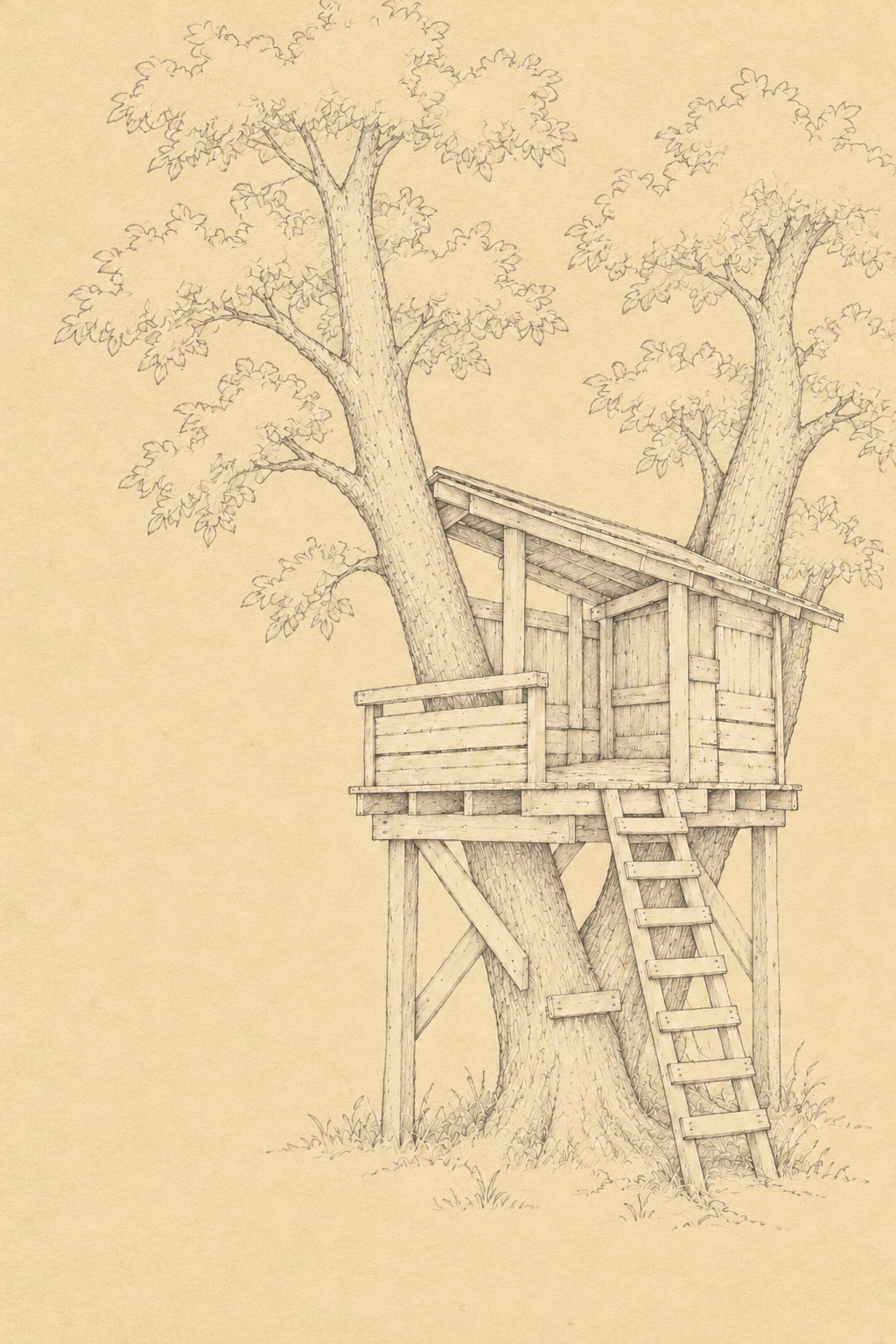
Some places feel special when we find them alone.
But childhood often begins properly the moment a place becomes shared.
For the next few days, Iman thought about the river more often than he expected.
Not all the time.
Not in a way that distracted him from breakfast or holiday mornings or the small routines of home.
But often enough.
A patch of moving sunlight.
The sound of water from somewhere far off.
A row of trees at the side of the road.
Small things had begun reminding him of the place behind the path.
And the more he thought about it, the more it began to feel like the kind of place that should not be visited only once.
By the third morning, curiosity had grown into certainty.
He would go back.
This time, he left the house a little earlier.
The road was still quiet, the light still soft, the morning still carrying the unhurried feeling of days that belonged entirely to children.
His bicycle moved more confidently beneath him now.
He no longer needed to think about every turn or every stretch of road. His body had begun trusting the rhythm of movement, and that trust made the ride feel easier than before.
He found himself grinning without really knowing why.
The morning felt too open to stay quiet, and somewhere in his head he began humming a tune he didn’t quite remember learning. It wasn’t loud, not something anyone else could hear — just a small, steady happiness that seemed to move along with the turning of the wheels.
When he reached the row of trees, he did not hesitate.
He leaned the bicycle against the same trunk as last time and followed the narrow path inward.
The air beneath the branches felt cooler again, and the sounds of the road disappeared quickly behind him.
Soon the familiar sound reached him.
Water.
And then the river appeared once more, quiet and steady beneath the filtered light.
But this time, he was not alone.
Voices drifted across the clearing before he fully stepped into view.
Aisha was there, seated on one of the flat rocks near the water.
Beside her stood a boy Iman recognized vaguely from the neighbourhood — taller, louder-looking somehow, with the kind of energy that made stillness seem unlikely.
Another boy sat nearby with a notebook in his lap.
And a third, quieter than the others, crouched near the riverbank watching something in the water.
Aisha noticed Iman first.
“You came back,” she said.
Iman nodded.
The louder boy turned immediately.
“So you’re the one she found the other day.”
Iman blinked.
Aisha frowned.
“That sounds strange when you say it like that.”
Adam grinned.
“Well, it is strange. He just appeared from the trees.”
Aisha ignored him and looked back at Iman.
“This is Adam.”
Adam gave a quick nod, as if his introduction required no further explanation.
Aisha pointed toward the boy with the notebook.
“That’s Raffy.”
Raffy looked up and gave a smaller, more polite nod.
“And that’s Nael.”
Nael glanced over from the riverbank and offered a quiet half-wave before returning his attention to the water.
Iman looked at them, then back at the river.
“You all come here too?”
Adam answered before anyone else could.
“Of course we do. This is our place.”
Aisha looked at him.
“It is not your place.”
“It is partly my place.”
“You found it after I did.”
“That’s not the point.”
Raffy closed his notebook with a sigh that suggested this argument had happened before.
Iman smiled before he meant to.
Something about the way they spoke to one another felt easy. Not rehearsed. Not formal. Just the natural shape of people who had already spent enough time together to stop trying too hard.
Aisha noticed his expression.
“What?”
“Nothing,” Iman said quickly, though he was still smiling.
Adam stepped closer and folded his arms.
“So can you climb?”
Iman frowned.
“What?”
Adam pointed upward.
Only then did Iman notice the tree properly.
It stood near the edge of the clearing, slightly apart from the others, its branches wide and strong above the riverbank.
A few rough wooden planks had already been tied between two lower branches.
Not enough to be called a structure yet.
But enough to suggest intention.
“We’re building something,” Adam said.
“By ‘we,’” Raffy added, “he means he had an idea and expects everyone else to help.”
Adam ignored him.
“A treehouse.”
Iman looked up.
The branches spread wide enough to hold one. The height was just dangerous enough to feel exciting.
For a moment, the idea seemed too perfect to be accidental.
A hidden river.
A quiet clearing.
A strong tree.
It felt exactly like the sort of place children were supposed to claim before the rest of the world noticed it existed.
“You think it’ll work?” Iman asked.
Adam looked offended.
“Of course it’ll work.”
Raffy adjusted the notebook in his hands.
“It might work if someone thinks before doing things badly.”
Nael stood and brushed the sand from his hands.
“The branches are strong enough.”
Aisha looked at Iman.
“We need one more person anyway.”
Iman glanced at her.
“For what?”
She smiled slightly.
“To help make it real.”
That was enough.
The rest of the morning passed in the kind of busy, half-serious effort children naturally treat as important.
Adam tried to take charge of everything.
Raffy corrected him repeatedly.
Nael noticed which branches held more weight.
Aisha tied knots more neatly than anyone else.
And Iman, without realizing it, slipped into the rhythm of the group as though some part of him had been waiting for it.
They passed pieces of wood upward.
Tested balance.
Argued about where the entrance should be.
Changed their minds.
Changed them again.
By midday, the structure was still far from finished.
But it was no longer imaginary.
A small floor had taken shape between the branches.
Uneven.
Slightly unstable.
Beautiful.
Adam climbed up first, naturally.
Then Aisha.
Then Iman.
Raffy followed with visible distrust of the entire project.
Nael came last.
For a brief moment, the five of them sat there in a silence that felt larger than the unfinished treehouse itself.
Below them, the river moved softly through the stones.
Above them, leaves shifted against the bright sky.
And around them, the world seemed to hold still just long enough to let childhood believe in permanence.
Adam looked around proudly.
“We need a rule.”
Aisha looked at him.
“Why?”
“Because every important place needs rules.”
Raffy sighed.
“That is not true.”
“It is true,” Adam insisted. “And I have one.”
Nael leaned lightly against the wooden frame.
“What is it?”
Adam looked at all of them, suddenly more serious than usual.
“No one tells.”
The words landed more softly than expected.
The others looked at him.
He shrugged, but not carelessly this time.
“If this is our place…” he said, glancing around the treehouse as if seeing it more clearly for the first time, “…then we’re the ones who keep it.”
There was a brief pause.
Then he added, quieter now:
“This place stays ours.”
For once, no one laughed. Because they all understood what he meant.
A place becomes more important the moment it is shared in confidence.
Aisha held out her hand toward the middle of the small wooden floor.
Not dramatically.
Just simply.
Adam placed his hand over hers.
Then Raffy.
Then Nael.
Iman looked at them for a second before placing his hand with the others.
Five hands.
Afternoon light.
A half-built treehouse above a hidden river.
No ceremony.
No witnesses.
Only the strange seriousness children sometimes carry without fully understanding why.
Adam smiled first.
“The Treehouse Pact.”
Aisha laughed softly.
“That sounds ridiculous.”
“Maybe,” Adam said. “But it’s official now.”
And somehow, it was.
Years later, Iman would remember that moment with surprising clarity.
The warmth of the wood beneath his hands.
The movement of leaves above them.
The quiet certainty that life, at least from where they sat that day, had finally begun to belong to them.
Of course, life rarely keeps its earliest promises in the form we imagine.
But that morning, none of them knew that yet.
And perhaps that was the most beautiful part.
Some promises are never written down.
They survive only in memory, in places, and in the version of ourselves that first believed them.